Estimated Reading Time: 16 minutes
Table of Contents
Introduction
What does it really take to build wealth?
For many people, the answer seems simple: earn more, spend less, and invest the difference.
But building lasting wealth is rarely about a single brilliant investment decision or a shortcut to financial freedom. More often, it is the result of ordinary financial decisions repeated consistently over many years.
The challenge is that earning a good income does not automatically make someone wealthy. A rise in income can easily be accompanied by rising expenses, unnecessary debt, inadequate insurance, and lifestyle upgrades that quietly consume money that could otherwise be invested.
India’s household savings pattern also highlights why the distinction between saving and building wealth matters. RBI data tracks household savings across financial assets, physical assets, and other forms of saving, showing that households do not necessarily direct all their savings toward financial investments.
At the same time, participation in financial markets is increasing. AMFI data shows that equity mutual funds recorded positive net inflows for 61 consecutive months through March 2026, while SIP assets stood at ₹15.11 lakh crore at the end of March.
These trends are encouraging. But investing more money is only one part of the wealth-building equation.
Developing strong financial habits can make a significant difference in how effectively you manage money and build long-term wealth.
True financial progress comes from developing the right habits—and following them consistently.
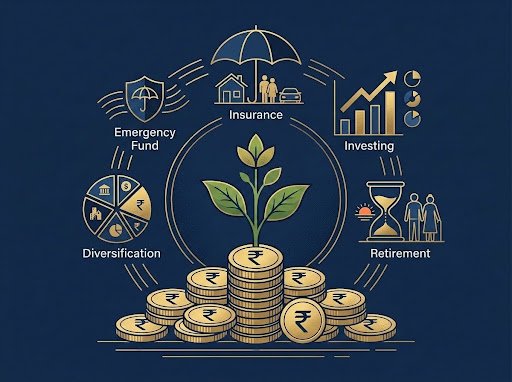
Here are seven financial habits that can help you build a stronger foundation for long-term prosperity.
1. Control Lifestyle Inflation Before It Controls You
One of the biggest obstacles to wealth creation is not necessarily a low income. It is the tendency to increase spending whenever income increases.
This is known as lifestyle inflation.
Imagine that your salary increases by ₹15,000 a month. You could use the additional income to increase your investments, strengthen your emergency fund, repay debt, or work toward a major financial goal.
Or you could upgrade your phone, move into a more expensive apartment, eat out more frequently, or take on another EMI.
There is nothing inherently wrong with enjoying the benefits of a higher income. The problem begins when every increase in income automatically becomes an increase in expenses.
Why lifestyle inflation matters
Your ability to build wealth depends not only on how much you earn but also on how much of that income you can consistently retain and put toward meaningful financial goals.
Consider two people who each receive a ₹15,000 monthly raise.
One increases monthly spending by ₹15,000.
The other continues living largely within the previous budget and directs most of the increase toward savings and investments.
After several years, their financial positions could look dramatically different—even though their incomes were identical.
Practical approach
You do not need to eliminate every lifestyle upgrade.
Instead:
- Increase your savings or investment amount whenever your income rises.
- Consider investing a substantial portion of salary increments and bonuses before increasing discretionary spending.
- Give yourself a defined budget for entertainment and lifestyle purchases.
- Review recurring expenses regularly to identify expenses that have quietly increased.
Takeaway: Increasing your income is valuable, but increasing the amount you keep and invest can be even more powerful for long-term wealth creation.
2. Build a Real Emergency Fund
An emergency fund may not make you rich, but it can prevent a financial setback from destroying the wealth you are trying to build.
A sudden job loss, medical expense, major home repair, or unexpected family responsibility can create a significant financial burden.
Without a cash reserve, many people are forced to borrow money or liquidate investments at an inconvenient time.
This is why an emergency fund should come before aggressive long-term investing.
How much should you keep?
A commonly used starting point is three to six months of essential living expenses.
However, the appropriate amount depends on your circumstances.
You may need a larger reserve if:
- Your income is irregular.
- You are self-employed or a freelancer.
- You are the primary income earner in your family.
- You have dependants.
- Your industry has a higher risk of employment disruption.
- You have significant unavoidable monthly commitments.
The important point is that your emergency fund should be based on essential expenses, not your entire lifestyle budget.
Where should you keep it?
The emergency fund’s primary purpose is safety and accessibility, not maximum returns.
It should generally be kept in an easily accessible, relatively low-risk form rather than being fully exposed to equity market fluctuations.
Keep it separate from your everyday spending account to reduce the temptation to use it for non-emergency purchases.
Takeaway: Your emergency fund is not designed to maximise returns. It is designed to protect your financial plan when life does not go as planned.
3. Make Compounding Work for You
If disciplined saving provides the money for wealth creation, compounding provides the potential for that money to grow over time.
Compounding occurs when returns generated by an investment are themselves allowed to generate further returns.
The most important ingredient is not excitement.
It is time.
Starting earlier can make a substantial difference because money invested for a longer period has more opportunity to compound.
Why consistency matters
India’s growing SIP culture illustrates how systematic investing has become increasingly popular.
According to AMFI’s March 2026 data, SIP assets stood at ₹15.11 lakh crore, while equity mutual funds recorded their 61st consecutive month of positive net inflows.
However, the lesson is not that every SIP will automatically create wealth.
The real lesson is the importance of discipline, appropriate asset selection and a sufficiently long investment horizon.
A simple example
Suppose you invest ₹5,000 every month for a long-term goal.
The amount may initially seem insignificant compared with a large financial target.
But regular contributions, combined with potential investment growth over many years, can gradually build a substantial corpus.
The exact outcome will depend on the investment, return, fees, taxes and time period. Market-linked investments do not provide guaranteed returns.
Practical approach
- Start with an amount you can sustain.
- Automate your investment wherever appropriate.
- Increase your contribution as your income grows.
- Avoid constantly stopping and restarting investments because of short-term market movements.
- Choose investments based on your goals, time horizon and risk tolerance—not simply on recent performance.
Takeaway: Compounding rewards patience. Starting early and remaining consistent can matter more than constantly searching for the next “best” investment.
4. Protect Your Wealth Before Trying to Grow It
There is a temptation to focus entirely on investments when discussing wealth creation.
But wealth can disappear much faster than it is created.
A major medical expense, the death of a primary earner, disability or another serious financial shock can potentially wipe out years of savings.
This is where insurance becomes part of a wealth-building strategy.
Insurance does not create wealth in the traditional sense. Its purpose is to transfer certain financial risks to an insurer in exchange for a premium.
Life insurance
If your family depends on your income, adequate life insurance can help protect them financially if you die prematurely.
For many income-earning individuals with dependants, term insurance is worth considering because it provides life cover without bundling it with an investment component.
The amount of cover should be based on factors such as income, liabilities, dependants, future financial goals, and existing assets—not simply on a single universal multiplier.
Health insurance
Health insurance is equally important.
Even a household with substantial savings can face a major financial setback if a serious medical event results in large out-of-pocket expenses.
Employer-provided health insurance can be valuable, but relying exclusively on employer coverage may leave a gap if you change jobs or leave employment.
Review your protection.
Review your insurance whenever your circumstances change significantly—for example, after marriage, the birth of a child, taking a large loan or experiencing a major change in income.
Takeaway: Investment returns can help build wealth. Insurance helps protect the wealth you have already built.
The key to successful money management is not adopting these financial habits overnight but turning them into consistent routines.
5. Start Planning for Retirement Earlier Than You Think
Retirement can seem distant when you are young.
That is precisely why it is easy to postpone.
But retirement planning is one of the clearest applications of the power of compounding. The earlier you begin, the more time your investments have to potentially grow.
Why retirement planning needs attention
Many people underestimate how much money they may need after they stop earning an active income.
Consider the expenses that can continue—or even increase—in retirement:
- Housing and household expenses
- Healthcare
- Insurance premiums
- Inflation
- Family responsibilities
- Travel and lifestyle expenses
- Unexpected financial needs
At the same time, employment income eventually stops.
Do not rely on one source.
Retirement security may come from a combination of resources, depending on the individual’s circumstances:
- EPF
- NPS
- Mutual funds and other investments
- Bank deposits
- Pension income
- Other retirement assets
The appropriate combination depends on age, income, risk tolerance, retirement goals and existing assets.
Practical approach
Start by estimating how much you may need in retirement.
Then work backwards:
Retirement goal → Time available → Required savings → Appropriate investment strategy
Review the calculation periodically because income, inflation, expenses and retirement expectations can change.
Takeaway: Retirement planning is not something to begin when retirement is approaching. The earlier you begin, the more manageable the journey can become.
6. Build and Protect a Healthy Credit Profile
Your credit history may not feel like an investment, but it can have a meaningful effect on your financial life.
A healthy credit profile can make it easier to access credit on potentially more favourable terms, while poor credit behaviour can make borrowing more expensive or difficult.
India is also seeing increasing awareness of credit scores.
According to TransUnion CIBIL, 183 million consumers had self-monitored their CIBIL score by December 2025. The organisation reported that the average score among monitoring consumers was 728 and that nearly 45% improved their score within six months of monitoring.
These figures do not prove that simply checking a score causes improvement. However, they do illustrate a broader shift toward consumers taking a more active interest in their credit profiles.
Healthy credit habits
- Pay EMIs and credit card bills on time.
- Avoid taking unnecessary loans.
- Keep credit utilisation under control.
- Check your credit report periodically for errors.
- Avoid applying for multiple loans or credit cards unnecessarily.
- Borrow only when the repayment fits comfortably within your financial plan.
Remember
A good credit score should not become an excuse to borrow more.
Credit is a financial tool—not additional income.
Takeaway: A healthy credit profile can reduce financial friction, but the strongest credit habit is still responsible borrowing and timely repayment.
7. Diversify Your Wealth Instead of Depending on One Asset
Many Indian families have traditionally preferred physical assets such as property and gold.
There is nothing wrong with owning either.
The problem arises when almost the entire financial future of a household depends on one asset class.
Diversification is designed to reduce the risk of relying too heavily on one investment.
Why diversification matters
Different assets behave differently under different economic conditions.
Equities can offer long-term growth potential but also exhibit substantial volatility.
Debt instruments can provide greater stability but may offer lower long-term growth potential.
Gold can serve a diversification role, but it does not generate regular cash flows as a productive business does.
Real estate can be valuable but is relatively illiquid and may involve significant transaction costs.
The objective of diversification is therefore not to predict which asset will perform best next.
It is to avoid having one asset determine the success or failure of your entire financial plan.
Practical approach
Your asset allocation should reflect:
- Your age
- Financial goals
- Investment horizon
- Risk tolerance
- Existing assets
- Income stability
- Liquidity requirements
Review your portfolio periodically rather than constantly reacting to market headlines.
These financial habits are simple to understand, but consistently practising them can have a powerful impact on your financial future.
Takeaway: Diversification is about managing risk intelligently—not about owning as many investments as possible.
Analysis: Where India’s Wealth-Building Journey Stands Today
India’s financial landscape is changing rapidly.
Several important trends deserve attention.
1. Financial-market participation is increasing.
AMFI data shows sustained equity mutual fund inflows and significant SIP participation. Equity mutual funds recorded their 61st consecutive month of positive net inflows in March 2026.
This suggests that systematic, market-linked investing is becoming increasingly familiar to Indian households.
2. Credit awareness is improving.
TransUnion CIBIL reported that 183 million consumers had self-monitored their CIBIL score by December 2025, with non-metro consumers accounting for around 75% of those monitoring.
This indicates that financial awareness is spreading beyond India’s largest cities.
3. Financial literacy still needs improvement.
The NCFE’s 2019 Financial Literacy and Inclusion Survey remains an important reference point, but it should not be presented as a current 2026 measurement. The survey showed that only a minority of respondents crossed the minimum financial-literacy threshold, highlighting the continuing importance of financial education.
This creates an important distinction:
Having access to financial products is not the same as understanding them.
4. Protection remains essential.
Insurance should be considered alongside saving and investing because financial wealth can be severely affected by unexpected risks.
IRDAI continues to publish detailed insurance statistics in its annual reports and insurance statistics handbook, making these primary sources preferable when discussing India’s insurance sector.
Practical Recommendations
The Right Order Matters
A strong financial plan is not simply a collection of good habits. The sequence in which you develop those habits also matters.
For many households, a sensible framework is:
1. Manage essential expenses
↓
2. Build an emergency fund.
↓
3. Put appropriate insurance protection in place.
↓
4. Control high-cost debt
↓
5. Begin long-term investing
↓
6. Increase investments as income grows.
↓
7. Review and rebalance the overall plan.
This sequence is not a universal prescription. Individual circumstances differ. But it helps prevent a common mistake: trying to maximise investment returns while ignoring basic financial protection.
Common Mistakes to Avoid
1. Increasing spending every time income rises
A higher salary does not have to mean a permanently higher standard of living.
2. Investing without an emergency fund
Long-term investments should not be your first line of defence against a short-term emergency.
3. Chasing quick returns
There is no reliable shortcut to sustainable wealth creation.
Promises of extraordinary returns with little or no risk should be treated with extreme caution.
4. Ignoring insurance
A single major financial shock can undo years of disciplined saving and investing.
5. Treating credit as income
A credit card or loan increases purchasing power—but it does not increase your wealth.
6. Concentrating everything in one asset
A portfolio dominated by a single asset class can expose you to unnecessary risk.
7. Constantly changing investments
Frequent switching can result from emotional reactions to market movements rather than sound financial planning.
Implementation Tips
Building wealth does not require you to change everything overnight.
Start with a few simple actions:
Automate good financial behaviour.
Automate savings and investments where appropriate so that they happen consistently rather than depending on willpower.
Give every rupee a purpose.
Divide your income among essential expenses, financial protection, short-term needs, long-term goals and discretionary spending.
Increase investments gradually.
When your income increases, consider increasing your savings and investments before increasing your lifestyle.
Review your financial health annually.
At least once a year, review:
- Emergency fund
- Insurance coverage
- Outstanding debt
- Investments
- Retirement savings
- Credit report
- Major financial goals
- Asset allocation
Keep learning.
Financial products, tax rules and regulations change over time. Use reliable sources such as RBI, SEBI, IRDAI, PFRDA, AMFI, and other official investor education resources when making financial decisions.
Key Takeaways
- Lifestyle discipline creates the surplus that can eventually become wealth.
- An emergency fund protects your long-term financial plan from unexpected expenses.
- Compounding rewards time, consistency and patience.
- Insurance protects accumulated wealth from major financial risks.
- Retirement planning should begin long before retirement approaches.
- A healthy credit profile can support responsible borrowing and better financial management.
- Diversification reduces dependence on any single asset class.
- Financial education is essential because access to financial products does not automatically mean understanding them.
Conclusion
Building wealth is rarely about discovering one extraordinary investment.
It is about doing ordinary things with exceptional consistency.
Control lifestyle inflation.
Save before you spend.
Build an emergency fund.
Protect yourself with appropriate insurance.
Invest for the long term.
Manage debt responsibly.
Plan for retirement.
Diversify your assets.
And keep learning.
None of these habits is particularly complicated on its own. The real challenge is following them for years—even when there is no immediate reward.
The good news is that you do not need to become wealthy before you start behaving like a wealth-builder.
Wealth is often built quietly, through small financial decisions repeated consistently over a long period of time.
Your financial future is not determined by one decision.
It is shaped by the habits you repeat.
The seven financial habits discussed above can help you create a stronger foundation for long-term financial security.
Disclaimer
This article is intended for educational and informational purposes only and should not be considered personalised financial, investment, insurance, tax, or legal advice. Financial decisions should be based on your individual circumstances, financial goals, risk tolerance, and time horizon. Investment and market-linked products are subject to risks, and past performance does not guarantee future results. Please consider consulting a qualified financial professional before making decisions about your finances.
Sources & References
- Reserve Bank of India (RBI) — Handbook of Statistics on the Indian Economy and related household savings data.
- Association of Mutual Funds in India (AMFI) — Monthly Mutual Fund Industry Update, March 2026.
- National Centre for Financial Education (NCFE) — Financial Literacy and Inclusion Survey / National Strategy for Financial Education.
- Insurance Regulatory and Development Authority of India (IRDAI) — Handbook on Indian Insurance Statistics 2024–25 and annual insurance publications.
- TransUnion CIBIL — CIBIL for Every Indian: Uncovering How India Owned Its Credit Journey in 2025.
Editorial note: Financial statistics can change as new official data becomes available. Figures in this article should therefore be understood as reflecting the latest authoritative data available at the time of writing.